Make It Make Sense - Ep. 01 - A Silhouette Culture: Who Is The Modern Australian?

Old mate Mick from down the road. Lives about a stone's throw away. Ripper bloke, once you get to know him anyway.
We all know Mick, even if you didn't understand a word of the backwater jargon you've just read.
He's a rough-and-tumble, knockabout guy who doesn't take life too seriously. He's always rocking a tight cotton singlet, mid-thigh length footy shorts and pluggers (thongs/flip flops) that expose arguably too much of his deeply sunburnt skin matted with unruly body hair. You'll catch him down the local footy parked up on a wheelable 50-litre Esky packed with cold stubbies of VB, or down the pub in his Hi-Vis after a hard yakka day on the tools. He's a true blue, fair dinkum, ridgy-didge cobber who takes the piss and gives as good as he gets.
Mick is an internationally-renowned and instantly recognisable figure. He's an archetype of Australian culture.
So many of us have met a Mick or two, whether you identify as Australian or claim to have met one in a hostel somewhere in western Europe. But for every Mick, you meet dozens of other Australians who resemble an entirely different cultural identity, from physical appearance to cultural beliefs and attitudinal values.
Australia's development in the post-war era has been remarkable, in step with the trajectory of the broader western economic world that the nation is associated with. Transitioning to a service-based economy, technological advancement and the local impact of regional and global migration has changed the face of modern Australia.
For many living in Australia today, Mick is no longer the common man. Which begs the question - who is the modern Australian?
A Silhouette Culture: A Familiar Shadow
After returning from three months abroad across South East Asia and moving further west towards Parramatta into the heartland of suburban Sydney, I began to notice that the perception and reality of life in Australia was hard to reconcile.
As a descendent of European and British immigrants and having lived in predominantly Anglo-centric, my cultural character resembles what could be considered 'traditional colonial Australian'. And yet, the re-assimilation back into Australia felt strangely foreign to me.
While I was abroad, I spent a lot of time looking forward to my world 'making sense' again. I had spent months navigating previously unknown cultural, social and societal parameters, only to come 'home' and find that I was struggling to understand a country that I was born and raised in.
Where I was still looked like home. I could still recognise the remarkably crisp and clean air, the warm glow of the radiant southern sun and the revered sounds of kookaburras and cockatoos singing. But it didn't quite feel like the same place anymore.
The Australia I had come to understand had transformed while I was still in it. It wasn't until I removed myself from the country that the narrative of 'who Australians are' began to unravel in my head.
Coming back to Australia felt like seeing Mick in a suit and tie. You don't quite recognise him at first. You might make a joke at his expense before conceding that he actually looks quite good. But it's not what you're used to.
Where did the old Mick go?
Australian Culture: Beyond A Textbook
Academic literature contains countless definitions of culture, but many hold the same core premise. Culture is an intangible construct that defines a social group, consisting of values and beliefs, behaviours and actions, and tangible objects that outwardly communicate the underlying principles of the group.
Under a broad conceptualisation, defining Australian culture is an incredibly unique challenge.
Australia is an adopted-nation. As a young, colonial state, the nationally-dominant Australian culture is a derivative of broader English and Anglo-spheric cultural elements. With only two-hundred years of post-colonial settlement, the national identity of Australia has only experienced a brief period of adaptation relative to the context of history.
Compare that to countries with extensive lineage such as China or India, who have multiple belief systems and religions coupled with hundreds (if not thousands) of regional language variations and centuries of cultural development.
Culture in these countries is highly complex, nuanced and fragmented. An Indian person who lives in Mumbai, speaks Tamil and aligns to the Hindu faith belongs to a starkly different cultural subgroup than an Indian living in Hyderabad, speaking Telugu and aligning to Islamic faith.
Australia's compressed post-colonial history means that the culture hasn't had the exposure to the depth of political, economic and social reform that challenges, stretches and reforms national or regional identity. Additionally, this context doesn't acknowledge the struggles associated with colonial Australia's reconciliation with indigenous culture.
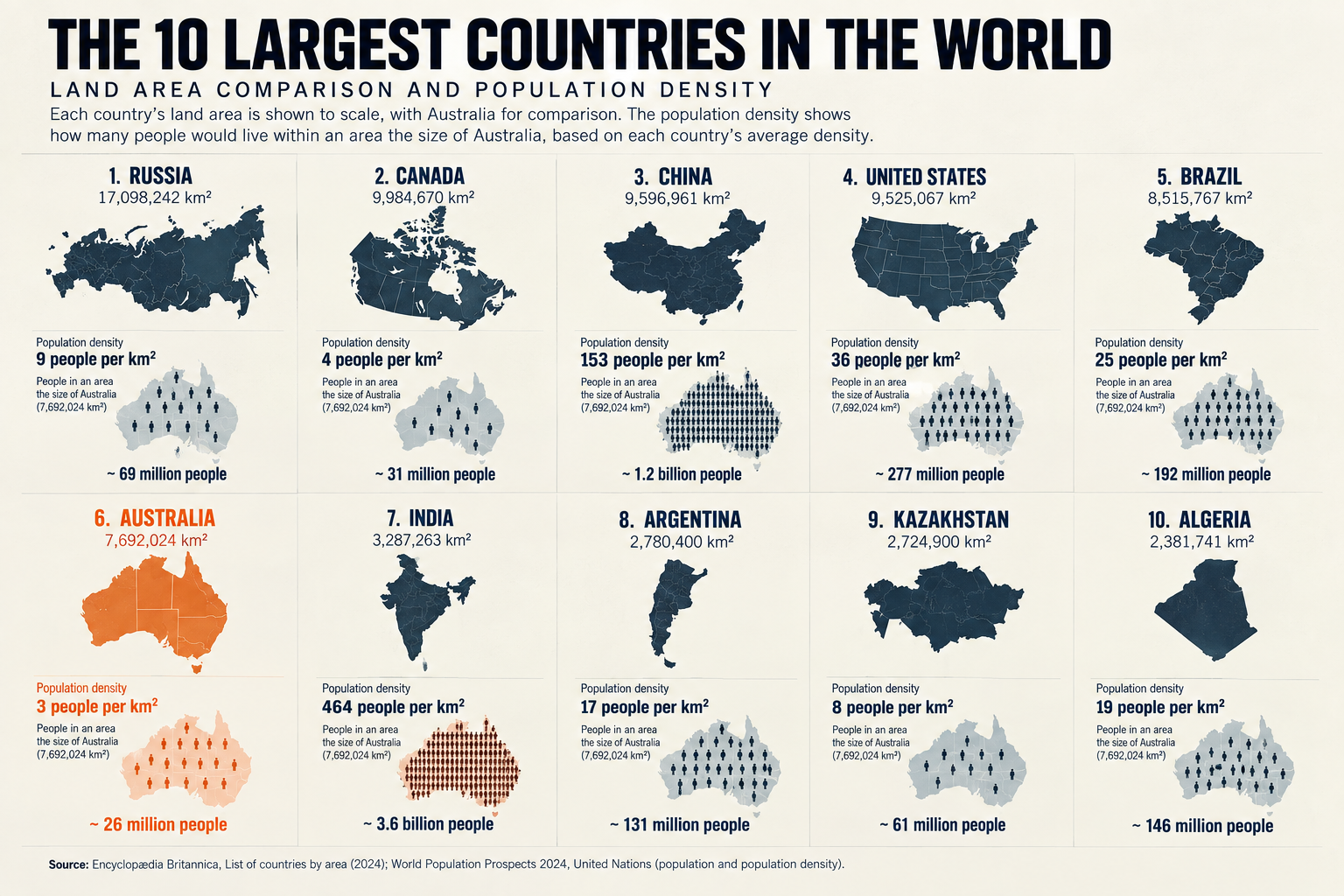
Beyond history, a key component of Australia's cultural identity is its geographic uniqueness. Amongst the top 10 largest countries in the world, Australia is the least densely populated.
The Asian megacities of Tokyo, Delhi and Shanghai have larger populations than the entire country.
When comparing major cities, Australia has a considerably more dispersed urban landscape. Sydney, Melbourne & Adelaide are dwarfed when compared to major metropolitan centres around the world.
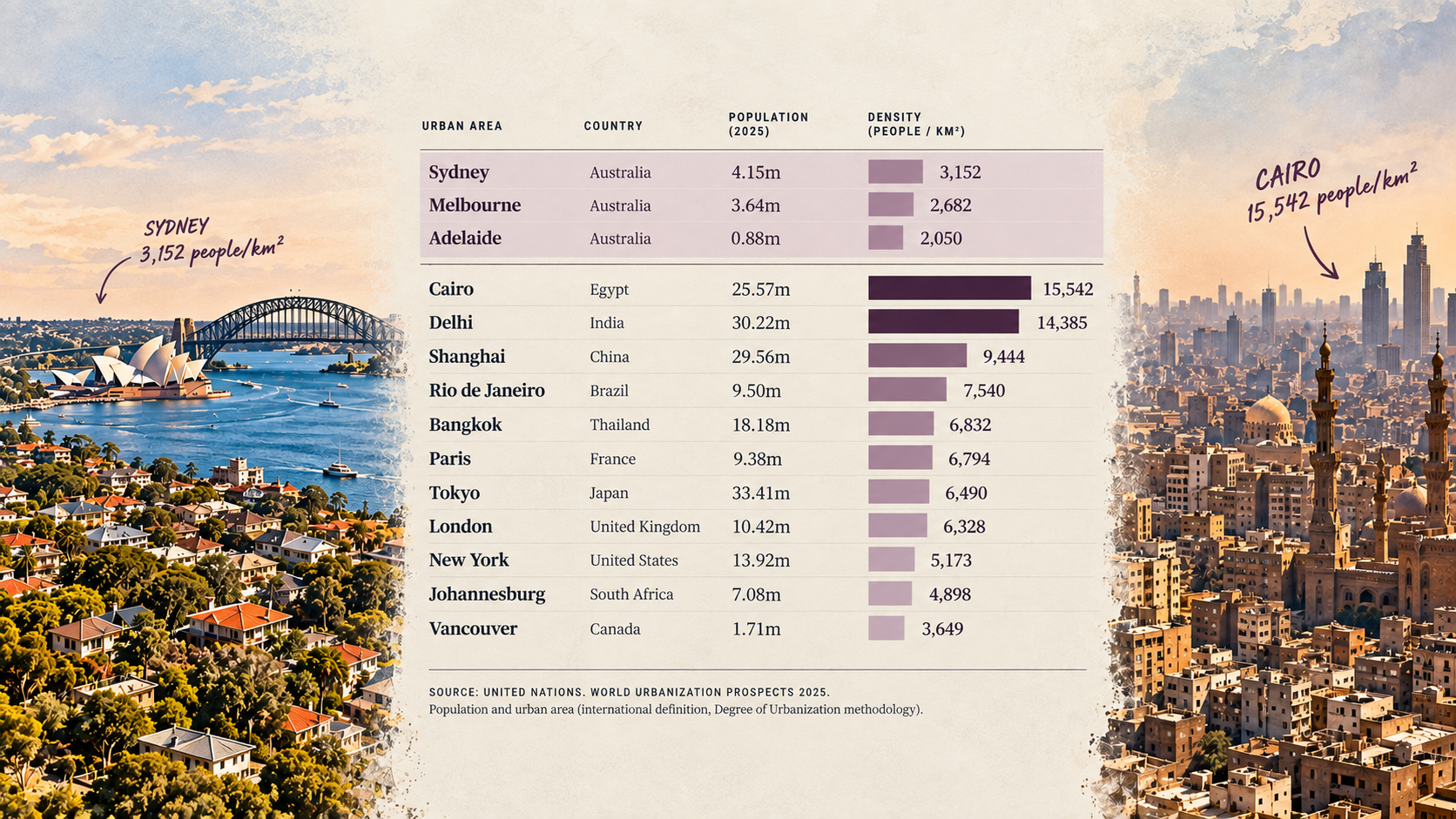
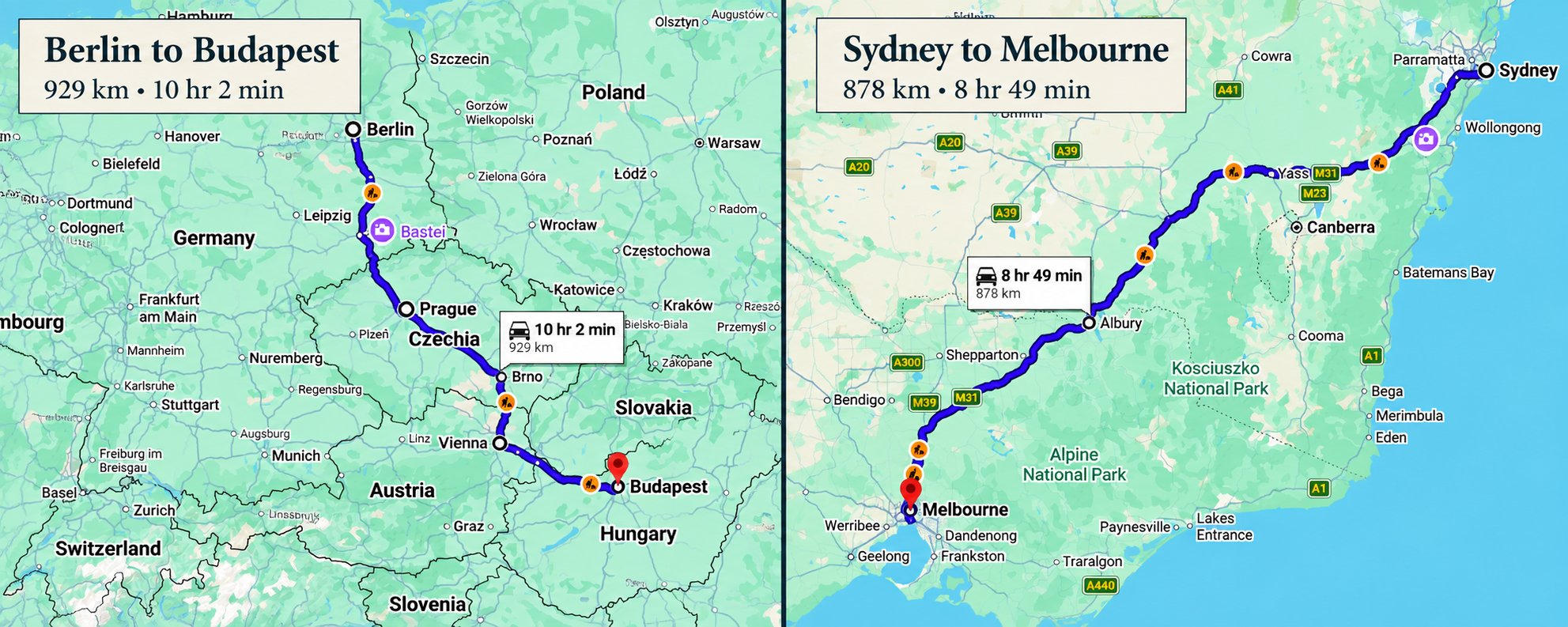
If we consider that Australian people living in major cities could be culturally comparable, there's more absurdity to consider. Driving between Sydney and Melbourne - the two biggest cities in Australia - covers almost the same land distance as a four-country road trip from Berlin to Budapest through Prague and Vienna. And yet, it'd be obtuse to claim that east Germany, central Czechia, north-east Austria and west Hungary share an equivalent culture.
Even within major cities, Australians are subjected to Frankenstein-style infrastructure that makes connecting to other parts of their cities inherently difficult. For example, a public transport-based commute from West Ryde in Sydney's inner-northwest to Marrickville in Sydney's inner-west requires three separate modes of transport and can take upwards of 60-90 minutes. The same 18-kilometre journey takes ~30 minutes by car, at an average speed of 35kmph, AND costs $15 in tolls for a return trip.
Australians are spatially separated by both nature and design.
Given the role of proximity in developing social ties, a physically-distant population presents a challenge in consolidating or solidifying a national identity.
Physical limitations aside, the formation of Australian culture has continued to dynamically evolve as the world becomes an increasingly globalised landscape.
Australia has a strong political and economic association with the western world, most notably the United Kingdom and the USA. This is in direct opposition to its geographic location on the continent of Oceania with immediate proximity to Pacific nations, south-east Asia and sub-continental Asia.
There may not be a greater representation in the world of 'east meets west' than Australia.
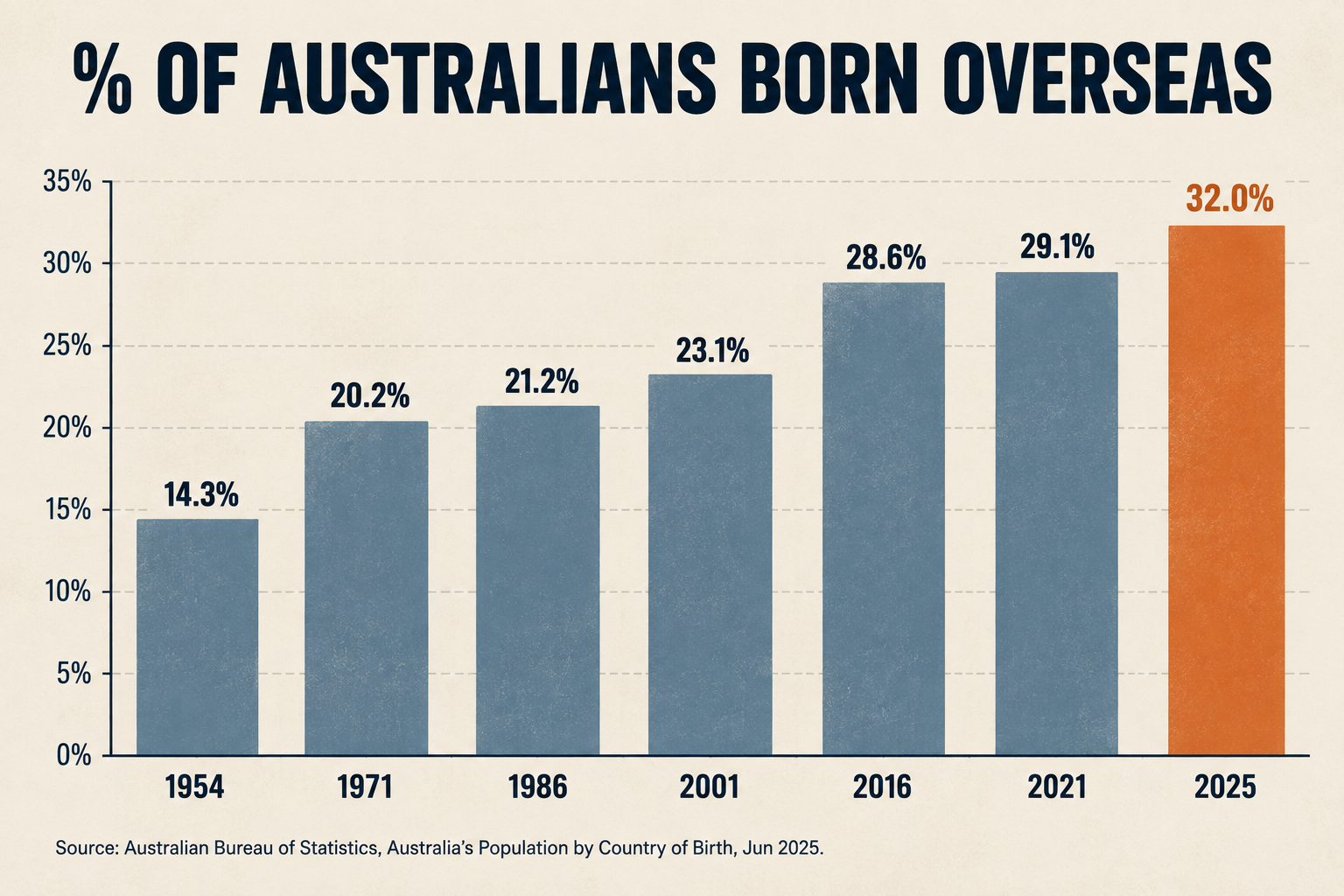
Post-war migration has also played a fundamental role in the continued evolution of Australian culture. In 1954, 14% of Australians were born overseas. In 2025, this had risen to 32%. The dynamicity of the national population is further amplified by highlighting that over half of all people living in Australia are first or second generation immigrants.
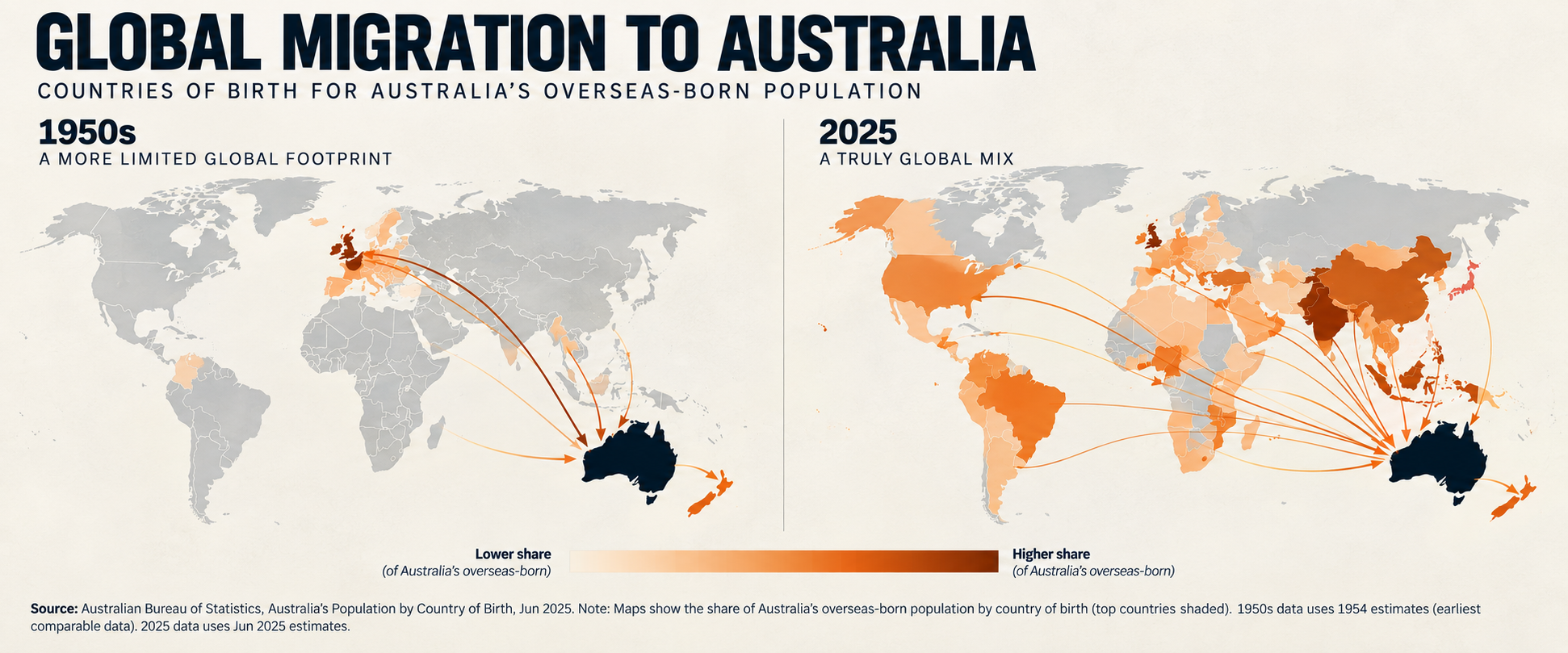
Beyond sheer volume, the composition of immigration has changed substantially. The immediate post-war era was almost exclusively Anglo-centric. In addition to the UK, Italians, Greeks, former Yugoslavians, Polish, Dutch & German populations represented the greatest influx of new Australians.
Fast-forward to the 2020s and 'The Asian Century' has well and truly engulfed Australia. The number of Indian-born people living in Australia has increased 9-fold, from 103k to 971k in the last 75 years. Influxes of immigrants from the likes of China, Phillipines, Sri Lanka, Vietnam, Malaysia and Nepal has been a prevailing trend in the last quarter-century. European migration has slowed dramatically.
The popular vernacular of the late 1990s-early 2000s was that Australia is 'multicultural'. Yet, these cultures didn't integrate seamlessly. People have a built-in mechanism to seek belonging, which created urban pockets of different ethnicities throughout major cities.
In Sydney, Punchbowl & Lakemba is a Middle-Eastern heartland. Street signs and shopfronts in Burwood and Strathfield are written in Chinese and Korean, with English as an afterthought. Every second restaurant in Leichhardt and Haberfield serve pizza and focaccia. Harris Park might just be the best Indian and Sri Lankan food outside of sub-continental Asia. Cabramatta markets attracts visitors from all over Sydney for a comparably-authentic south-east Asian shopping experience, with arguably the largest concentration of Vietnamese & Chinese ancestry in the entire country.
If one of every two modern Australians were born into or raised in a variety of cultural environments, it becomes increasingly difficult to defend a singular Anglo-spheric definition of Australian culture that produced the national archetype.
How many Micks are still out there?
Strengths & Shadows - Through Rose-Coloured Glasses
Under the presumption that Australia's immediately recognisable caricature is still the dominant representation of the national culture, there's significantly more psychological depth than what appears superficially.
Australians may be renowned for their jovial, easy-going nature and not taking life all that seriously. But this is starkly contrasting to many parts of the world, and the most pronounced, commonly-lauded elements of the national culture have inherent drawbacks:
- "Bought Tickets On Yourself" - Implicit advocacy for social equilibrium and fairness that punishes ambitious or proud people who deviate from the social norm.
- "She'll Be Right" - Resilience, adaptability and optimism that masquerades a reluctance to show vulnerability, care deeply or openly try.
- "Take The Piss" - Leveraging humour to break down social hierarchy and find enjoyment in everyday life whilst negating any real sense of earnestness.
- "Stick By Your Mates" - Strong sense of loyalty that can inadvertently alienate outsiders and people who may be different from you.
- "Good Bloke" - An openness for fun yet superficial social interaction without developing deeper and meaningful connections.
- "Don't Be A D!ckhead" - Do whatever you want, as long as you don't do anything that pisses anyone else off. Develops a strong sense of self-cohesion and awareness of the collective while creating invisible rules and encouraging conformity.
Importantly, this is all theoretical and statistically unproven. On an individual level, I think you'd be hard-pressed to find many Australians who actively revoke the idea of trying to achieve a goal, better yourself or care about something. Most Australians that I know are warm, kind and inviting by nature.
Mick might be a good bloke, but do you even really know him?
Aussie Culture's Barrier of Participation
Even if you wanted to talk to Mick, you'd have to speak his language.
One of Australia's most notorious cultural elements is linguistics - the way that Australians speak is incredibly unique. The everyday Australian often bastardises the English language, relying extensively on short-hand, colloquialism, accentuations, inflections, analogies and environmental context to communicate.
Even people who come from English-speaking nationalities, or people who grew up learning how to speak English, struggle to comprehend Australian speech. The national vernacular is so distinct that English, Irish, American and Canadian people struggle to understand the entirety of a verbal exchange with a 'classic Aussie'.
I often recall a moment from 2023, sitting in a taxi in Uruguay with a very chatty yet exclusively Spanish-speaking driver. In an attempt to communicate, I said "yeah nah si", receiving rapturous laughter from my Irish mate in the backseat who admonished me for "f^cking up three languages in one sentence".
"Yeah, nah, si" - Aussie Spanglish by Dean Rutty, 2023
Let's use a classic example to illustrate the point.
- "Hey mate" - generic, straight, brief, soft consonants, no inflections, broad higher pitch tone. I don't know you but we're about to have a transactional yet pleasant exchange.
- "Heeey maaattee" - elongated vowels, extended upwards inflection into 'mate'. You're most likely a friend of mine who I haven't seen for a while, and I'm excited to see you.
- "Hey, mate" - short but notable pause. I don't know you, and you've probably done something that has pissed me off.
- "Heeeyy! Maatee!" - Slightly elongated vowels, upwards inflection with brief but notable consonant pause. You're probably a stranger, and I'm trying to get your attention because something has happened or I can help you.
- "Heeeeyyyyy maaaattteeee" - Very elongated vowels, hard consonant pause, downwards inflection to finish. You're a person close to me, and I'm expressing that I'm tired and/or sad.
The same two-word phrase can be delivered in a dozen ways, each with their own unique meaning but may overlap depending on the context of the conversation.
And don't even get me started on the differences between "yeah nah; yeah, nah; yeah nah yeah; yeah nah yeaaahhhhh; nah yeah nah; nah yeah; nah, aw yeah".
The essence of the problem is that an Australian audience can easily understand the translation of the last few paragraphs. In a literal sense, "hey mate" should just be a greeting for a friend. Yet, the social, cultural and environmental cues that affect the delivery of the phrase significantly alter the substantive meaning.
Beyond the uniquely Australian dialect, social norms are designed around implicit conformity.
Within the unwritten social contract, eating or drinking loudly, playing Instagram or TikTok reels on public transport without headphones, speaking on the phone in a quiet room or performing live music in a public space is deemed as unacceptable behaviour.
All of these actions legally-allowed and have no impact on the safety or wellbeing of individuals or the broader collective. The rhetoric may dictate that Australians are easy-going and carefree, but there is an unabridged connotation that your behaviour should automatically consider the impact on the people around you.
Traditional Australia's difficult-to-interpret social governance framework creates a perplexing and paradoxical inflection point. As the nation becomes increasingly culturally diverse, is it possible for implicit and nuanced social norms to become universally understood? Or does the high barrier for participation eventually create a more fragmented society?
The Silhouette Is Changing Shape
My three-month absence from the Australian cultural landscape may have been the catalyst for this article, but it wasn't the basis of it. Almost every Australian would be experiencing a similar phenomenon, whether knowingly or subconsciously.
Disappointingly, migration has become weaponised in the political sphere. Change-resistant Australians are latching to false narratives of growing ethnic diversity leading to job theft, rental price rises, congestion and dilution of 'traditional culture'. However, like all political opinions, these views are laden with perspective, bias and agenda.
Australia's scattered cultural texture is one of it's most compelling characteristics. Picture this as a Saturday. Wake up, grab one of the best coffees in the entire world. Go for a walk on a well-maintained footpath in a scenic, natural environment. Get a traditional Thai foot massage to recover. Woodfire pizza and a glass of red wine from Marseille for lunch. Watch a game of rugby league or AFL in a Victorian-era style pub. Stop in half-pissed at your local Turkish restaurant for a kebab. Grab an Uber home and talk cricket with a man who moved to Australia from Bangalore two years ago.
The question is - do we all need to be like Mick? Or is Mick now a part of something bigger?
Make It Make Sense
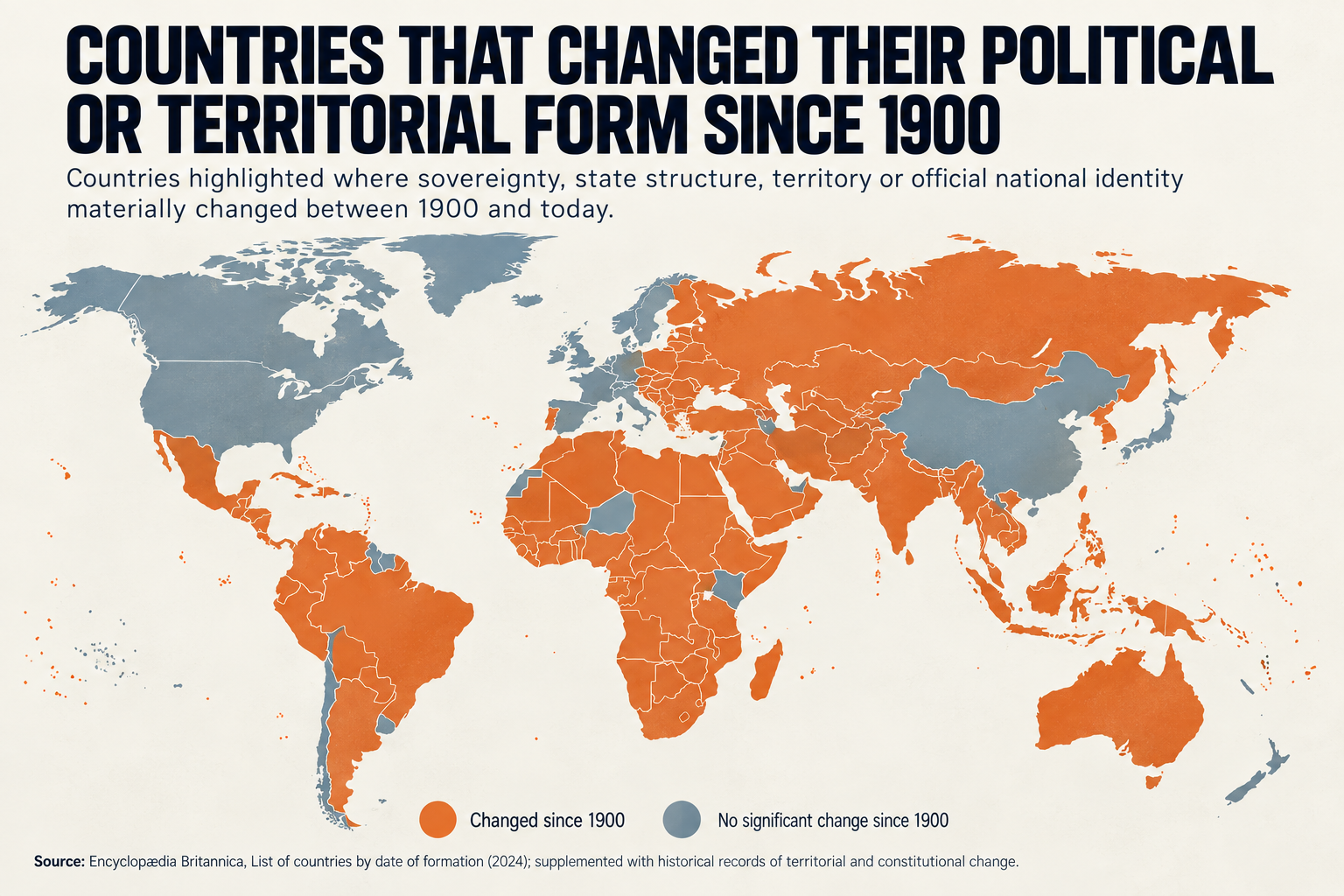
As the world continues to accelerate towards an increasingly digital and global landscape, the concept of national identity that dominated the historical landscape of the 20th century may be increasingly challenged. Roughly 60% of countries in the world have changed an element of their definition since 1900. With so much change in the last 125 years, what precedent is there to suggest that this framework will remain unchanged into the future?
Australia's continuous evolution has been shaped by millions of people choosing to traverse half a planet to live here. It's been a critical part of developing the character of the nation and Australians have embraced this for the most part. Yet, the common rhetoric hasn't necessarily moved with the infrastructure that sits underneath it.
Mick is still a good bloke. But he isn't the only bloke. You don't need to be like him to consider yourself an Australian. And you never had to be.